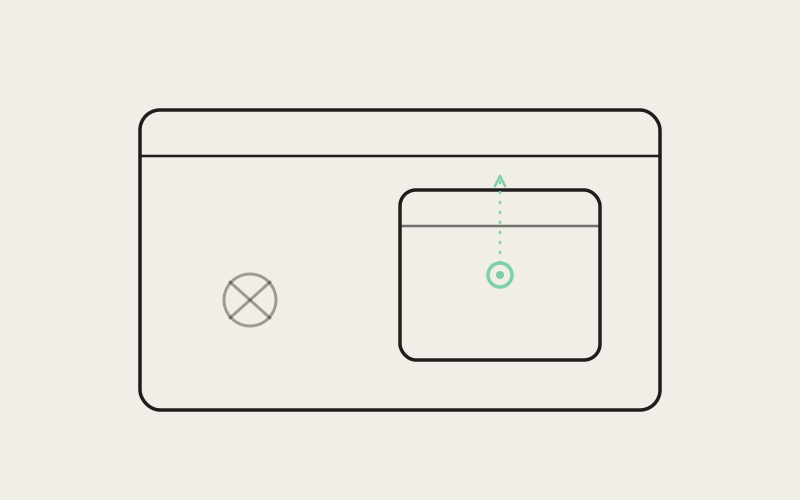
An agent running inside WSL2 can look completely healthy in its own terminal — happily editing files, running tests, committing — while Influxx's sidebar shows nothing at all. No error, no red badge, just silence. That silence is the symptom of a networking assumption baked into WSL2 itself, and fixing it required moving a listener across the Windows/Linux boundary rather than trying to punch a hole through it.
The Problem: A Listener That's Reachable From the Wrong Direction
Influxx tracks what a coding agent is doing — provisioning, running, waiting on input, completing a task — through a hook pipeline. Agent CLIs are configured to call a small hook client at key lifecycle moments, and that client reports the event back to Influxx over a local loopback connection. On native macOS and Linux this is unremarkable: the hook client and the listener share the same network namespace, loopback works the way everyone expects, and the event shows up in the sidebar within milliseconds.
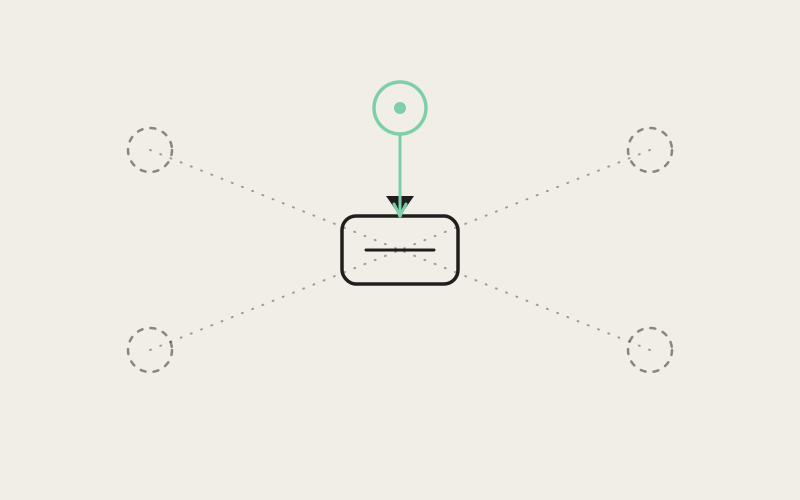
WSL2 breaks that assumption in a specific, easy-to-miss way. WSL2 runs the Linux guest in a lightweight utility VM with its own virtualized network adapter, and Windows sets up NAT-based forwarding between the two. That forwarding is asymmetric: traffic to localhost is forwarded from Windows into WSL, but not the other direction. A hook client running inside the WSL guest that tries to reach a loopback listener bound on the Windows side simply cannot connect — the connection fails before it ever leaves the guest's own network stack.
What makes this genuinely dangerous rather than just annoying is how the hook client is designed to handle that failure. Hook clients fail open on purpose — a coding agent's actual work should never be blocked or slowed down because a status-reporting call didn't land. That's the right default for reliability, but it means a broken connection produces no error, no retry storm, no log line a user is likely to see. The agent just keeps working, and Influxx's sidebar keeps showing whatever the last known state was, typically nothing. From the user's side, an agent that's actively running looks indistinguishable from one that never started.
A Second, Independent Gap: Hooks Weren't Even Installed Where They Needed to Be
The networking issue wasn't the only thing standing between Influxx and a working WSL2 setup. Every hook installer in Influxx — the code responsible for writing hook configuration files and the hook scripts themselves — wrote exclusively to the Windows-side home directory. For an agent CLI running natively inside WSL, that's simply the wrong filesystem. WSL and Windows have separate home directories, and there was no WSL-targeted install path at all. So even before you get to the question of whether a hook client inside WSL can reach a listener on Windows, there was a more basic problem: the hook files it would need to invoke in the first place were never written to where that agent could find them. Both gaps had to close for WSL2 support to actually work end to end.
Why Not Just Open a Port and Bridge Across It
The instinctive fix — bind the Windows-side listener on all interfaces, or forward a specific TCP port across the WSL boundary — trades one problem for a worse one. It means reasoning about a network-exposed listener, firewall prompts, and port collisions on every machine Influxx runs on, for a feature that's purely internal bookkeeping between a CLI hook and a desktop app. Influxx already had a working pattern for exactly this situation, though: SSH-remote worktrees relay hook events from a remote host back to the local app over the SSH connection itself, using the channel Influxx already owns because it spawned the remote process. WSL2 turned out to be structurally the same problem — a process running somewhere Influxx can't put a reachable listener — so the fix reused that pattern almost directly.
"Once we framed WSL2 as 'a remote host that happens to be a few nanoseconds away,' the SSH relay design just applied. We weren't inventing a new trust boundary or a new event format — we were reusing the one that already forwards hook events over stdio for remote worktrees, just with a WSL guest as the far end instead of an SSH session."
— Priya Ranganathan, Staff Engineer, Agent Runtime at ETAPX
How the Fix Actually Works
A Relay That Lives Inside the Guest
Influxx now spawns a small relay process directly inside the WSL guest. That relay binds to WSL's own internal loopback address, on the exact same port unmodified hook clients were already configured to call. This is the detail that makes the fix invisible to everything upstream of it: the hook client inside the agent's environment doesn't change at all. It still dials loopback on the same port it always did — it just now finds something listening on the correct side of the network boundary, inside WSL itself, instead of failing silently against an unreachable Windows-side socket.
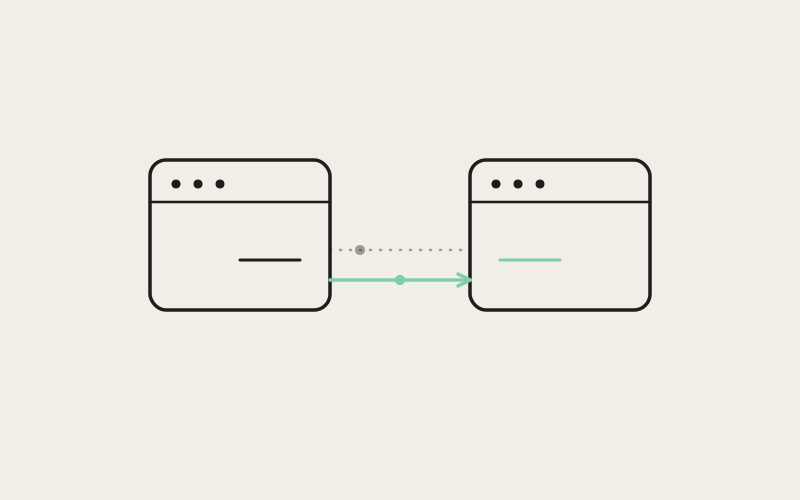
Because Influxx spawned that WSL process directly, it owns the process's standard input and output streams outright. The relay uses that stdio channel to forward each received hook event back to the Windows host — no socket, no port, nothing for a firewall or antivirus product to flag. It's the same trust boundary and the same event shape already used by the SSH-remote relay, so the Windows-side code that consumes these events didn't need new parsing logic or a new protocol; it already understood events arriving this way.
- No client changes required: hook clients keep dialing the same loopback port; only what's listening on the WSL side of that port changed.
- No exposed network surface: events travel over a process stdio pipe Influxx already controls, not a socket reachable from anywhere else.
- Shared code path with SSH remotes: the relay reuses the SSH-relay's event format and trust model rather than introducing a parallel one.
Fallback Behavior on Port Conflicts
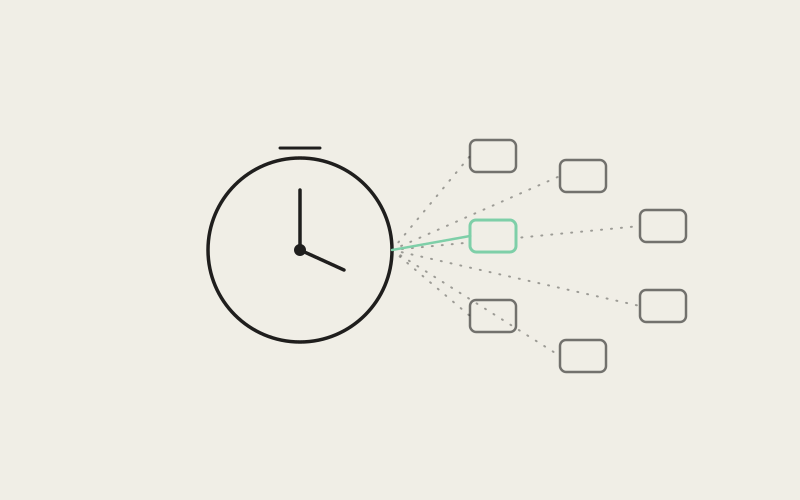
If something else inside the WSL guest is already bound to the expected port, the relay doesn't fail — it falls back to binding an OS-assigned port instead, and writes an endpoint file that the WSL side can read to discover where the relay actually landed. This mirrors, exactly, the fallback pattern the SSH relay already used for the same class of problem. Reusing that pattern rather than designing a new one meant the fallback path had already been exercised in production before WSL2 support existed, which matters a lot for something that only triggers in an edge case that's hard to reproduce on demand.
Clean Shutdown, No Orphaned Listeners
A relay process that lives inside a guest OS and forwards over a parent-owned stdio stream has one obvious failure mode: what happens when the parent goes away but the child doesn't? Influxx's relay is designed to exit the moment its own input stream closes. That's a deliberate design choice, not an incidental side effect — a lingering guest-side listener process, still bound to the hook port after Influxx itself has stopped caring about it, would be exactly the kind of silent blackhole that this whole feature exists to eliminate. If the parent connection is gone, the relay treats that as its own signal to shut down rather than sitting there accepting connections nobody will ever read.
What This Replaced, and Why the Numbers Mattered
WSL2 support at Influxx didn't start from zero — a first integration shipped earlier using an HTTP client tool as an interop bridge for one specific agent. That approach worked, but it paid a real cost under load: because it opened a new HTTP connection for every event rather than holding one open, it hit a fast connection timeout even when the listener on the other end was completely healthy, and events got dropped as a result. That's not a hypothetical concern for a status pipeline — a dropped "agent completed" event is exactly the kind of thing that leaves a session looking stuck in the sidebar when it isn't.
The resident relay approach eliminates that cost structure entirely. Because the relay is a long-lived process bound inside the guest for the life of the agent session, there's no per-event connection setup at all — no timeout window to race against, no handshake to redo for every single hook call. Events get forwarded over an already-open stdio pipe, which is about as cheap as inter-process communication gets.
Rather than retiring the older HTTP-based bridge once the relay shipped, Influxx kept it in place as a fallback. Some WSL distros don't have a local script runtime available at all, which the relay depends on to run inside the guest. For those environments, the original bridge is still the only option, so it stays in the codebase deliberately rather than being cleaned up as dead code.
"I run my main dev environment in a WSL2 Ubuntu install and had basically written off the sidebar status tracking as a Windows-only feature. When it started actually reflecting what my agent was doing — provisioning, running, done — without me changing anything in my WSL setup, I assumed I'd missed an update note somewhere. Nice surprise either way."
— Marcus Oyelaran, platform engineer at a logistics software company, Influxx user
Two Races Caught Before Shipping
Adversarial review of the design turned up two race conditions that don't show up in a quick manual test but would have caused real problems in the field.
- Distro auto-boot race: detecting which WSL distro to target requires probing it, and a naive probe can itself trigger Windows to boot a distro the user had deliberately shut down. A user who stopped a distro to free up memory or CPU shouldn't have Influxx quietly restart it just by checking whether it exists.
- Orphaned relay child race: an identity race in how the relay process was tracked could, under the wrong timing, leave a relay child process that nothing could subsequently kill — the exact opposite of the "exit when stdin closes" guarantee the design was supposed to provide.
Both were fixed to fail safely rather than patched around: the distro-detection path no longer risks booting a stopped distro as a side effect of a status check, and the process-identity handling that could orphan a relay child was corrected so the exit-on-stdin-close guarantee actually holds under concurrent conditions, not just in the common case.
"The bug that scares me isn't the one that throws an error, it's the one that boots a VM the user deliberately turned off, or leaves an orphaned process nobody can kill without knowing where to look. Neither of those show up in a normal test pass. That's exactly why we don't ship this kind of cross-boundary process work without someone actively trying to break it first."
— Felix Adeyemi-Strand, VP of Engineering at ETAPX
Validated End to End
This isn't a design that was validated only against unit tests of the relay in isolation. It was run live on a real Windows 11 machine with WSL2, driving an actual coding agent through a full session: provisioning showed up correctly in the sidebar, status transitioned live as the agent worked, a completion notification fired when the agent finished, and — critically — resuming the session worked across a full app restart, relying on the same daemon-survives-restart guarantee that keeps PTYs alive for every other Influxx session. That last point matters specifically for WSL2: the relay has to be something the daemon can re-establish or reattach to cleanly, not a one-shot process that only survives as long as the app window is open.
Why This Matters for Developers on Windows
Anyone doing serious development on Windows today is very likely doing it inside WSL2 — it's the default recommendation for running Linux-native toolchains, and a large share of coding-agent CLIs assume a POSIX environment. A desktop cockpit that unifies notes and agent terminals but goes dark the moment an agent runs inside WSL2 isn't a minor rough edge for that audience, it's a dealbreaker. The fix described here isn't a workaround bolted onto the side of Influxx's architecture — it's the same relay pattern already trusted for SSH-remote worktrees, applied to a second class of "process running somewhere Influxx can't directly listen." That reuse is what let two previously-independent gaps — missing hook installs inside WSL, and an unreachable loopback listener — get closed together, cleanly, instead of as two separate patches layered on top of each other.
Frequently Asked Questions
Do I need to change any hook configuration to get WSL2 support working?
No. The hook client still dials the same loopback port it always used; the fix changes what's listening on the WSL side of that connection, not what the client does.
Does this open a network port that WSL2 or Windows Firewall will prompt me about?
No new network-exposed port is introduced. The relay inside WSL binds to WSL's own internal loopback, and events reach Windows over the relay process's standard input/output stream, which Influxx owns because it spawned the process directly.
What happens if the relay's port is already in use inside my WSL distro?
The relay falls back to an OS-assigned port and writes an endpoint file the WSL side reads to find it, the same fallback pattern already used by Influxx's SSH-remote relay.
Will a WSL2 agent session survive an app restart or crash?
Yes — this was explicitly validated: resuming a session across a daemon-surviving terminal after restarting the app worked in the same live Windows 11 plus WSL2 test that verified provisioning, status transitions, and completion notifications.
What if my WSL distro doesn't have a local script runtime?
Influxx falls back to the original HTTP-client-based interop bridge, which was kept in place specifically for distros where the relay's dependency isn't available, rather than removed once the relay shipped.
Could this accidentally start a WSL distro I've shut down?
That was an identified risk during review — a distro-detection probe that could inadvertently boot a stopped distro — and it was specifically fixed so status checks don't have that side effect.
Why not just have the hook client retry or expose the Windows listener on all interfaces?
Retrying wouldn't help, since the connection fails outright due to WSL2's one-directional localhost forwarding, and exposing a listener more broadly trades an internal reliability problem for a network-exposed one; relocating the listener into the guest avoids both.
The actual fix here wasn't a networking trick — it was recognizing that a WSL2 guest and an SSH-remote host are the same kind of problem in disguise, and that a channel Influxx already owns by virtue of spawning the process beats any amount of cleverness spent trying to make two separate network namespaces see each other.