A hook that correctly decides to do nothing should be the safest code path in the system. In Influxx's agent-hook runner, it was the one most likely to leave a pipe half-closed and a writer stuck. The bug was small — a few lines of shell in the wrong order — but it touched every one of the 30+ agent CLIs Influxx integrates with, on three different scripting platforms, because the same ordering mistake had been copied into every generated script template.
The Problem: A Guard That Ran Before the Read
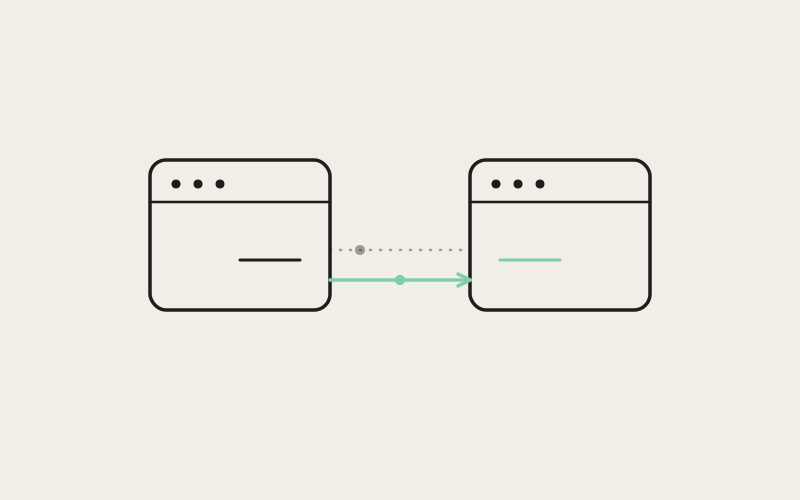
Influxx's hook system exists so that agent CLIs — Claude Code, Codex, Cursor, Droid, and the rest of the 30-plus integrations Influxx supports — can notify the app when something interesting happens: a tool call, a file edit, a session event. The mechanism is deliberately simple. Influxx generates a small hook script for each provider and each install target, the agent CLI is configured to invoke that script on its own event schedule, and the hook runner spawns the script as a child process and writes an event payload — typically JSON — directly to that child's standard input immediately after spawning it.
That "immediately after spawning" detail is where the bug lived. Every generated script starts with some kind of guard: is the right environment variable set, is this the provider the script expects, is there anything to actually do here? Guards are good practice — they're what let a hook script exit cleanly instead of doing unnecessary work. The problem was ordering. The guard checks ran first, and the stdin read ran second, inside the branch that actually needed the payload. If a guard decided to no-op and exited before ever touching stdin, the payload the hook runner had already written — or was in the middle of writing — had nowhere to go.
The result is a broken pipe on the write side. The hook runner's write call fails, because the reader it was writing to closed the other end of the pipe without ever reading. POSIX and Windows report this differently — different error surfaces, different error codes — but it's the same underlying bug class on both: a legitimate, correct decision to no-op turned into a plumbing failure, because the script closed a pipe it hadn't finished draining.
"The instinct when you're writing a hook script is to fail fast — check your guard conditions up front and bail immediately if they don't hold. That's correct logic and wrong pipe hygiene at the same time. If you're the reader on a pipe, you have to read it, or read enough of it, before you're allowed to walk away. Otherwise you're not exiting cleanly, you're just breaking something on the other end and letting someone else discover it."
— Priya Nakamura, Senior Engineer, Agent Integrations at ETAPX
Why This Is a Pipe-Ownership Bug, Not a Hook Bug
It's tempting to describe this as a bug in one hook script, but the more accurate frame is ownership. Once the hook runner spawns a child process and connects its stdin to that child, the child owns the read side of that pipe for the lifetime of the process — whether or not it ever cares about the contents. A script that exits without reading stdin hasn't just skipped a step; it has abdicated an obligation it implicitly accepted the moment it was spawned as the target of a piped write.
This is a general truth about process pipes, not something specific to Influxx's hook runner, but it's easy to lose sight of inside a small guard-clause script that was never designed with pipe semantics in mind — it was designed to check an environment variable and either continue or return. Every generated hook script, across every provider and every platform, needed to internalize the same rule: read your stdin first, decide what to do with it second.
- The hook runner's obligation: spawn the child, then write the payload to its stdin without assuming the child will ever look at it.
- The hook script's obligation: take ownership of stdin the instant it starts running, before any guard condition gets to make an early-exit decision.
- The failure mode when that contract breaks: a broken-pipe write error on the runner side, surfaced with a different error code on POSIX than on Windows, but caused by exactly the same ordering mistake.
The Fix on POSIX: Capture Before You Guard
The fix for the POSIX shell script template — the one Influxx generates for local installs, WSL, and SSH-remote worktrees alike — inverts the original order. Generated scripts now capture the entire stdin payload into a variable immediately, as the first statement in the script, before any environment check or provider-specific guard condition runs. Only after the payload is fully captured does the script evaluate whether it actually needs to act on it. If the guard says no, the script has already drained stdin and can exit cleanly with nothing left dangling on the pipe.
Because Influxx reuses the identical POSIX script template verbatim across local, WSL, and SSH-remote installs — Windows is the only target that branches to a separate script family — this single ordering change shipped atomically to every non-Windows install target at once. There was no separate rollout per platform variant to coordinate; fixing the template fixed every environment that consumes it.
The One Deliberate Exception
Not every provider treats "no payload" the same way, and the fix had to preserve that distinction rather than flatten it. One agent integration has an event contract that requires the hook to post something even when there's genuinely no input to report — for that provider, an empty stdin read maps to an empty JSON object rather than triggering an early exit. That's a semantic decision about what the receiving endpoint expects, not a bug, and it was kept intact deliberately: the capture-before-guard fix changes when the script reads stdin, not what a given provider is contractually supposed to do with an empty payload once it has it.
"We run a decent chunk of our agent workflows over SSH into a build box, and the failure we used to see was maddening precisely because it was intermittent — it only showed up on the runs where a hook legitimately had nothing to do. It looked like a flaky network issue for weeks until someone actually traced it to the hook script itself. Once it was explained as a stdin-ordering bug it made complete sense, but from the outside it just looked like random pipe errors in the logs."
— Sana Idrissi, DevOps lead at a logistics analytics platform, Influxx user
The Fix on Windows: Batch Scripts and a Shared Drain Routine
Windows needed a different mechanical solution because Windows batch scripting doesn't give you a clean, native way to slurp arbitrary stdin into a variable the way POSIX shell does. Influxx's generated batch scripts stream stdin directly into the HTTP client executable that actually delivers the event, rather than buffering the payload into an environment variable first. That's a deliberate constraint, not an oversight: buffering arbitrary JSON into a Windows environment variable risks corrupting special characters in the payload and running into environment variable size limits, neither of which is an acceptable failure mode for something as central as event delivery.
That constraint changes what "drain stdin before exiting" has to look like on Windows. When a guard condition in a batch script fails, the script can't just read-and-discard inline the way a POSIX script captures a variable — instead, failed guards jump to a shared drain routine that reads and discards stdin through a small platform utility built for exactly that purpose, so the pipe is closed properly no matter which guard branch triggered the exit.
PowerShell: Ownership Without an Extra Process
Influxx's PowerShell hook scripts follow the same ownership rule as the POSIX template, but PowerShell's native console-input handling lets it do so without spawning a helper process the way the batch scripts need. PowerShell scripts capture the full console input up front, before any endpoint or environment guard runs — mirroring the POSIX capture-first approach directly, just implemented with PowerShell's own input APIs instead of a subprocess utility.
Wrapper Scripts Needed the Same Discipline
The hook runner doesn't invoke the real hook script directly — it goes through a small wrapper script first, whose job is to check whether the target script even exists, is readable, and is executable before starting it. That wrapper sits directly in the path of the piped stdin write, which means it inherited the exact same ownership obligation as the hook scripts themselves, and it had the exact same gap.
If a wrapper decided the target script was missing, unreadable, or not executable, it would decline to start it — correctly — but the process that was supposed to read the payload never launched at all. The fix makes wrappers explicit stdin owners in their own right: when a wrapper declines to start its target, it now drains stdin itself before exiting, rather than leaving that responsibility to a downstream process that, by definition, never came into existence to claim it.
Centralizing the Fix Instead of Copying It
The most consequential engineering decision in this fix wasn't the ordering change itself — it was refusing to let that ordering change live as a pattern copied into every individual early-exit branch across every script template. With 30-plus agent integrations, multiple install targets, and several distinct guard conditions per script, a copy-paste discipline is exactly the kind of thing that holds for the first dozen call sites and quietly regresses on the next feature branch. The payload-capture logic was instead centralized into one shared module, so every generated script — POSIX, and the Windows batch/PowerShell family — pulls stdin-ownership behavior from a single implementation rather than reimplementing it per template.
"This is the kind of bug that's easy to underrate because no single instance of it is dramatic — one hook script, one broken pipe, one noisy log line. What made it worth fixing properly, at the module level, is that we have more than thirty agent integrations and three separate script-generation targets, and a per-template patch would have meant re-solving the same problem the next time someone adds a provider. Centralizing it means the next integration inherits correct pipe behavior automatically, instead of inheriting the bug."
— Marcus Aldeen, Head of Platform Engineering at ETAPX
Catching Regressions with an Oversized Payload
Ordering bugs like this are notoriously easy to reintroduce, because the failure only manifests under specific conditions — a guard that legitimately no-ops, combined with a payload write that's still in flight when the child exits. Small test payloads can pass cleanly through a broken script without ever exposing the bug, because a small enough write can complete before the reader closes the pipe. To make the regression catchable by an automated check rather than by a user filing a bug report weeks later, Influxx's verifier suite includes a dedicated script that launches a real, isolated instance of the app and exercises every generated POSIX hook script directly.
The verifier deliberately sends a payload larger than a typical OS pipe buffer for each hook it exercises. That size choice is the point: a write larger than the pipe buffer cannot complete in a single kernel-buffered pass, so if any generated script reads its guard conditions before draining stdin, the oversized payload reliably triggers the broken-pipe failure instead of getting lucky and slipping through. It's a test built around the exact mechanical condition that caused the original bug, rather than a generic smoke test that happens to invoke the scripts.
- What it launches: a real isolated instance of the app, not a mocked hook runner.
- What it exercises: every generated POSIX hook script, across the full set of supported providers.
- What it sends: a payload sized deliberately past a typical OS pipe buffer, so partial writes and early exits can't hide behind a payload small enough to complete instantly.
Why This Matters Beyond One Bug Fix
None of this changes what a hook script does functionally — the events fire the same way, the payloads carry the same data, the guards still make the same decisions about when to act. What changed is the reliability of the plumbing underneath all of it. A developer running agent workflows through Influxx doesn't see hook internals at all under normal conditions; they see a session that keeps working, notifications that keep arriving, and a daemon that doesn't log spurious pipe errors on runs where an agent's hooks correctly decided there was nothing to report. That's the payoff of a fix like this: it's invisible when it works, and it used to be visible — as unexplained noise in the logs — precisely on the runs that should have been the quietest.
It's also a fix that scales with Influxx's own integration surface. Every new agent CLI added to the 30-plus already supported gets its hook scripts generated from the same centralized templates, which means it inherits capture-before-guard stdin ownership automatically, on every install target, without anyone needing to remember to copy the pattern in by hand.
Frequently Asked Questions
Did this bug cause agent events to be lost, or just logged as errors?
The failure surfaced as a broken-pipe write error on the hook runner's side when a guard exited before draining stdin; the underlying issue was pipe hygiene in the generated scripts, not data corruption in payloads that were actually delivered.
Does this affect all 30+ supported agent CLIs, or just some of them?
It affected the shared script templates that every provider's generated hook script is built from, so the fix applies broadly rather than to a single integration — with one documented exception for a provider whose event contract intentionally requires posting an empty JSON object instead of exiting early on empty input.
Why does Windows need a separate fix from POSIX and PowerShell?
Windows batch scripting has no clean native way to buffer arbitrary stdin into a variable without risking corruption of special characters or hitting size limits, so batch scripts stream stdin directly into the HTTP client instead and rely on a shared drain routine for failed guards, while PowerShell can capture full console input natively, closer to how the POSIX template works.
Does this fix apply to SSH-remote and WSL installs, or only local installs?
Influxx reuses the identical POSIX shell script template across local, WSL, and SSH-remote installs, so the fix shipped atomically to all three at once — only the Windows install path uses a separate batch/PowerShell script family.
How is this kind of regression caught automatically going forward?
A dedicated verifier script launches a real isolated instance of the app and exercises every generated POSIX hook script with a payload deliberately sized larger than a typical OS pipe buffer, which reliably reproduces the exact ordering failure if it's ever reintroduced.
Was the fix applied script-by-script, or in one shared place?
The payload-capture logic was centralized into a single shared module rather than being copied into every early-exit branch of every script template, so new agent integrations inherit correct stdin ownership by default.
Do I need to change anything in my own hook configuration to get this fix?
No — the fix lives in how Influxx generates hook scripts, so any hook scripts regenerated after the fix automatically follow the corrected capture-before-guard ordering with no user-facing configuration change required.
A hook script that no-ops correctly and a hook script that no-ops safely are not automatically the same script — the difference is whether it took ownership of the pipe it was handed before it decided it had nothing to do with it.